Showing posts with label france. Show all posts

Tuesday, 22 February 2011

Sorceress on the Seine

So I'm never sure what I'm going to write about on any given day until I've gone on Wikipedia and read the brief description of what happened 'on this day' and seen who was born, and who died and so on. Anyway, on some days, nothing of real interest happens (or it was just wars and stuff and I am so sick of military history) and on other days, like today, loads has happened. 

For example, today marks the anniversary of George Washington's birth; the anniversary of the refounding of the Serbian Kingdom; the opening of the first Woolworth's; the day the Last Invasion of Britain began (which apparently has to be capitalized...); the first national conventions of both the Republican Party and the Prohibition Party (in separate years) and Dolly the sheep was cloned (yay, science!). So all of these things are clearly very Important and Significant and such and so I was wondering how I was going to get through the mountains of information out there about them and condense it down to a few paragraphs. Also, most of these are quite famous events, so a lot of people already know loads about them, which would probably make reading this quite boring.

But then, tucked away under the 'people who died on this day' section, I discovered Catherine Monvoisin, French sorceress. And I do love magic and fantasy, so I now present the life and times of a witch (who actually is pretty interesting!)

Catherine wasn't originally a witch. Born Catherine Deshayes, around 1640, she grew up around Paris and married a jeweller called Monvoisin. Unfortunately, Mr. Monvoisin wasn't a very good jeweller and they didn't have very much money at all, so Catherine started supplementing their income by practicing medicine - giving abortions or delivering babies as a midwife to women who needed them. This was not enough, however, so Catherine gave herself the name La Voisin and started practicing 'witchcraft'. At first, this was just face and palm reading, but soon she was providing love potions and poisons, and putting on shows, assisted by the magician Lesage (who was also her lover) and a renegade priest, who would perform a black mass - a parody of the Christian mass.

The ingredients lists for her love potions have been uncovered by historians, and well...I'm just glad I didn't have to try one of the poisons.  But anyway, if you maybe have a little crush on someone who's not reciprocating, why not slip a little something in a drink for them? The little somethings you could slip in could include: bones of toads, teeth of moles, Spanish flies, iron fillings (um...?), human blood or the dust of human remains. It'll totally work.

Anyway, these potions became very popular with the many mistresses of Louis XIV, four of whom at some point went to La Voisin and asked her to supply them with a poison to kill one of the other mistresses (and at one point, even the King himself). Maybe. Possibly. The 'evidence' for this is circumspect at best and even at the time, it could never be proven. 

However, sadly for La Voisin, the King's sister-in-law had died in 1676, and her death had been attributed to poison, supposedly given to her by the 'witch' Madeleine de Brinvilliers. Though it was later proven that her death was a result of a perforated peptic ulcer (do yourself a favour and don't Google image search that. Really.) the panic as a result of her 'poisoning' was still at its peak in Paris in 1679.

When La Voisin was accused of trying to kill one of the King's mistresses, she was swept up in a tide of fear and hysteria, and was naturally found guilty, even though no one could come up with any proper evidence. She was executed on 22 February 1680, burned at the stake for being a witch.     

Thursday, 20 January 2011

15 Reasons Why Wars Are Utterly Stupid & Daft:

15 Reasons Why Wars Are Utterly Stupid & Daft:

A list which came about because I am in the middle of revising for my final exam on the history of warfare, a topic I loathe, and the only interesting facts I manage to find about the battles are ones that are far to trivial to write about in an essay
and
because I like lists a lot. 
1) Shoes are important:
The Battle of Gettysburg, in 1863, remains the largest battle ever to have been fought on American soil. Ever. And do you know why it came about? Confederate General Robert E. Lee's army had no shoes, and when they found themselves outside the small Pennsylvanian town of Gettysburg, they thought to themselves, 'Oh hey guys, these Northerners have lots of shoes! Let's go raid the town for them!'. So they did. Where they happened to bump into the massive Union army, and realized that they'd better start fighting. The Confederates lost the battle, sadly, so I don't think they got any shoes at the end of it all. Sadface.

2) No really, they are: 
My friend Phil told me this story: during the Crimean War, the British were hopelessly disorganised, and decided to send all the left boots down to the Crimea on one ship, and all the right ones on another. And one of the ships sank. You couldn't make it up...

3) Actually, the whole of the Crimean War was a bit of a farce: 
I feel a bit bad making fun of the Charge of the Light Brigade, because so many people died, which is obviously a horrible thing, and would've been devastating for their families and everything, but the whole thing was completely preventable. British cavalry were given the order to charge up the 'Valley of Death', waving their swords about, whilst the Russians blasted them to pieces with cannons on all sides, thinking the British must be drunk.

4) To be honest, most nineteenth century wars were totally ridiculous:
Take the Franco-Austrian War of 1859, for example. It's a fairly insignificant one, in the grand scheme of things, but one thing it is famous for is the fact that the French had the bright idea to utilize the new railways to get their troops to the battlefield fresh and ready to fight, whereas the Austrians went on a two week march to get there. Anyway, the Austrians eventually cottoned on to this train business, and sent their reserve force to the next battle this way. Except they got off at the wrong station and completely missed the battle. Really.

5) And if they weren't missing battles, they were being inadequately prepared:
So a few years later, in 1870, the French were fighting the Prussians, and they had this amazing new weapon, called the matrielleuse. It was a forerunner to the machine gun, so if you were into slaughtering innocent soldiers, it should totally have been your weapon of choice. The Prussians should have been completely wiped out, but they weren't, because the French soldiers hadn't been trained in how to use their new gun, so it was effectively completely pointless.
 
6) Still, at least the French actually had an army:
After Charles II was restored to the throne, Parliament wanted to control his actions as they were afraid he'd do what his father had done, and plunge the country into Civil War again. Their solution, therefore, was to pay for and control the Navy, whilst allowing Charles an army only if he promised to pay for it himself. (Which, y'know, doesn't seem like the brightest move ever - 'Of course you can have an army! Just as long as you're in total control of it, not us! That'll ensure you won't try to attack us or anything...') In the end, Charles didn't attack the MPs (he was too busy partying and being a closet Catholic, two things which totally go together...) but for many years, the English army wasn't officially recognised as such, and the country at least technically had no army. 

7) However rubbish and unofficial the English army was, at least it wasn't full of sheep:
So the Civil Wars themselves were very complex, and their origins even more so, but one of the reasons they occurred was because Charles I needed money from Parliament for a war he was fighting in Scotland - the Bishops' War. In this war, England and Scotland were fighting over Bibles (as you do...), but the English army was much larger than the Scottish one, so the Scottish generals found themselves in a bit of a quandary. They decided that if they could trick the English into thinking their army was much larger than it was, they might be unwilling to fight them - and this plan turned out to be a good one. They did indeed manage to trick the English, by padding out their ranks with sheep, whom the English thought were...particularly woolly soldiers? God knows how this one worked...

8) Mind you, at least they weren't being paid in wool:
During the 100 Years' War, coinage was in short supply, so the English soldiers were paid in sacks of wool. Because all a fighting bloke really wants to do is learn to knit...

9) And about that '100' Years' War business:
Yeah, it actually lasted 116 years. But looking on the bright side, standards in numeracy had improved immeasurably by the time the Seven Years' War rolled round, and that ended bang on time, in 1763.

10) Also, at least numeric names make sense:
100 Years' War, 30 Years' War, Seven Years' War - they're all fairly logical, no? War of 1812 - that's another fairly self-explanatory one. The War of Jenkins' Ear...yeah, perhaps not. Though thinking about it, it started because Captain Jenkins had his Ear cut off by Spanish coast guards, so the name isn't that daft, even if the war itself was...

11) If you thought the names of wars were daft, wait until you hear what's going on on the battlefield:
So there's a very famous miscommunication about the First World War, where some field commander or another sent a message via telegram saying, "We're going to war, send reinforcements" but this got mistranslated and ended up as "We're going to a ball, send three and fourpence", and I can kind of see how this happened but honestly, didn't anyone think to check if this was the right message, coming from, y'know, a battlefield. War does this to people...  

12) Sometimes, people switch sides in the middle of conflicts:
Have you ever watched a children's cartoon and seen one of those montages where the good guys chase the monster through a door, then you see them turning around with the monster chasing them, then next thing you know, they're chasing the monster again, and no one knows what's going on? You have? Good. Visualize that happening in real life, 'cause it did: in 1460, the Earl of Warwick invaded (I'm assuming from some far distant land, and not, y'know, the well known island of Warwickshire...) captured Henry VI and installed Edward IV on the throne. Ten years later, in 1470, Warwick invaded again (oh who knows, maybe the Midlands were suffering from a lot of flooding around that time...), this time reinstalling Henry VI. You couldn't make it up...


13) We didn't get much better in World War Two either:
So Dunkirk was this terribly disorganised thing, where a load of British soldiers were trapped on a beach in Normandy with German soldiers advancing towards them and readying their planes to fly over and drop bombs on them, so the government requisitioned every ship on the south coast, even little two or three man fisher-boats to go out and rescue them, and they managed it, securing the rescue of the soldiers trapped on the beaches. In fact, everyone was so elated by the events that Winston Churchill had to make a special radio broadcast reminding the country that this wasn't actually a victory - in fact, it was a pretty awful defeat.


14)Anyway, sometimes you don't even need to fight, you can just employ a terrible euphemism plonk your warship in someone else's harbour:
As the British did when the Portuguese threatened to renege on their promise to grant independence to Brazil. No shots were fired and no fighting happened, but a stern warning was issued, and the best ship in the Navy set sail for Lisbon just to reinforce the point.

15) And sometimes, you just need to sound convincing:
In 1823, President James Monroe issued the Monroe Doctrine to the rest of the world, which basically said "Hey you guys? Yeah, don't attack us, 'cause we'll so get you back worse". Well, I'm not sure he said it quite like that, but that was definitely the general gist of things. Anyway, Spain and Portugal, who had both been planning to continue or restart old wars, backed down completely upon hearing this. Even though, at the time, the US had no navy and a very poxy little army. So really, all you need to do is sound threatening enough!

Oh my God. Am I condoning bullying?! Oh dear...         

Monday, 27 December 2010

The Port Wine Treaty

You know how you sometimes come across utterly, utterly ridiculous events in History? I think I may have just found one. Another one... Basically, I've just been reading about a treaty to end a war, which seems to be mostly about wine. WINE.

Now don't get me wrong, I have no problem with wine at all. But to sign a treaty promising an alliance based on the sale of wine...did no one stop to think that this would go down in History as something future generations might find slightly strange and somewhat amusing? No one at all?
 
The treaty in question was the Methuen Treaty, and it was signed on 27 December, 1703 by the countries of Portugal and England, and it wasn't totally about wine. At the time, there was a big war going on (the War of Spanish Succession) and all the big European powers were fighting it out to see who would become 'top dog'. The country of Portugal, whilst obviously a source of great importance and national pride to those who lived there, wasn't a big European power, and so consequently wasn't considered that important to the other countries. However, they did have a few good exports (namely wine), so they weren't going to be completely ignored by the other countries.

When the War of Spanish Succession broke out, in 1702, the Portuguese allied with the French, which basically meant that the French promised to protect them from attacks by the British navy (the French navy, whilst better than the Portuguese - which from some reports, seems to have consisted of two rowing boats and a dinghy - was not as good as the British, which was truly a force to be reckoned with, so Portugal's request for protection seems fairly understandable). 

However, the British kept sailing really close to Lisbon on their way to and from Cadiz, and the Portuguese were understandably upset when the French did nothing to stop them. Believing that they were untrustworthy, Portugal soon entered into negotiations with Great Britain to switch sides. (Because obviously, the way to counter untrustworthiness is to be even more untrustworthy!) This was very appealing to the British, as they believed that the war could be won much more cheaply and easily if they were able to use Portugal's deep-water naval ports to attack the French ports at Toulon, so the MP John Methuen was sent as an ambassador extraordinary to Portugal where he negotiated the treaty.

The treaty had three main parts. Firstly, it established the Alliance's war aims. Despite the fact that, at the time of the treaty, the war had been going on for a year or so, no one had thought to write down - or even officially state - why they were fighting, so the treaty duly noted that the purpose of the war was to secure the Spanish Empire for the Austrian claimant, the Archduke Charles, with whom Britain had already made an alliance, which was A Good Thing because it reminded everyone in the Alliance whose side they were on this time. 

The second part of the treaty was to do with the actual military part of the war - it established that Spain would become the main theater of war, and established things like the number of troops each country would provide - which again, is a very important thing in a war, and something you'd've thought they would have thought about earlier on in the conflict.

Finally, it 'regulated the establishment of trade relations between Britain and Portugal', or, in layman's terms, ensured that the British could keep drinking. Before the war, France had been supplying Britain with wine, which a lot of people found very agreeable. However, when they went to war, the French stopped trading with the British, and so no one had anything to drink, which many people felt was a Very Bad Thing. Now, the Portuguese realised that, as they had a wine industry, they would be able to fill this gap in British lives, but they were also scared that, when the war was over, the British would just revert to trading with the French and they would be stuffed. An agreement was come to, which stated that all trading between Portugal and Britain would be tax free, so the wine which was being imported would be able to be bought much more cheaply than any the French tried to sell. (Though technically, they were selling Port, rather than straight wine, which lead to a massive market for the drink in Britain, a fact which my Grandmother remains eternally grateful.) 

This makes sound economic sense and everything...it's just a shame that the treaty became known as the Port Wine Treaty, and no one in the country remembered anything about the parts which actually related to the war...

Friday, 8 October 2010

If I could explain it any better I'm sure I would

I'm a bit sad today. Not seriously so, you understand; it's mostly loneliness. I've taken a gap year, and all my friends have now jetted off to exotic locals Coventry, Wales, Manchester and the like to study new and exciting subjects Chaucer and Mathematics. Still, whatever floats their boats, eh? I, of course, don't begrudge them their time or happiness at their various universities - indeed, I am glad they all seem to be enjoying it so much. But sometimes, when I'm stuck in a tiny village with nothing going on in the arse end of nowhere, things do get a bit lonely.

And yet! It does not necessarily have to be so. I haven't really felt lonely all day - it's only now, when they're all out at the pub or various clubs, having lots of fun that I really miss them, because they're not here to talk to me. Over the course of today, I have spoken to my friends in Wales, Manchester, Shropshire, Coventry and Birmingham via a combination of email, instant message, text message, Skype, Facebook and Twitter (because I am cutting edge a poncy middle class child). If I wasn't so socially retarded, I could even phone them and see how their days had been. In a few weeks, I shall hop on a train and even visit a few of them.

So actually, I'm very lucky. A lot of people, even in this day and age, do not have the option to do any of this. Further back in time, very few people did. Carrier pigeons, whilst generally reliable, aren't always the speediest forms of communication, though they did have the advantage of being less likely to betray you or be intercepted than a rider on horseback was. If you wanted to stay in touch with someone in the thirteenth century, your options were pretty limited.

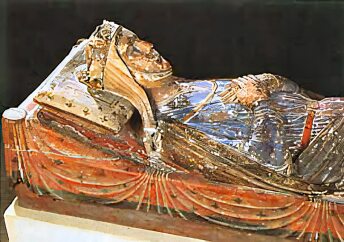
This brings me to Isabella of Angoulême. Clearly... On this day, in 1200, she was crowned Queen Consort of England, a few months after her marriage to King John I. This is Isabella (obviously quite a few years after her marriage...):


I'm not sure if you can tell from her tomb, but when she married John, on August 24th of the same year, she was heralded as a great beauty - medieval Historians sometimes call her the Helen of the Middle Ages. This was a double edged sword for her - the British people were, apparently, pleased to have such a beautiful wife for their King (and there was me thinking the excessive photoshopping of women in magazines and the like to "bring them up" to the required "standard" was a modern thing...), but she turned said King into a lazy scoundrel. Kings were expected to get up at five o'clock in the morning (effing hell) whereas John used to like to stay in bed with her until nearly midday. This was terribly shocking to medieval sensibilities, and didn't exactly do much for John's reputation as a good-for-nothing waster. The common people of England deemed her a siren, and she was well known for being vain.

Isabella was also French, as you may have guessed. Again this was a double edged sword, as whilst the French had made up the ruling elite ever since the Norman Conquest of 1066, there were still some displaced English nobles who considered themselves - or, to be more precise, their daughters - more worthy of the throne. But she did manage to provide the country with five healthy children, including the future King Henry II, so she was forgiven most things.

Despite the fact that she was so vain, well known for having a terrible temper to match her husband's, a clear royalist and a snob, who detested her lower ranking once her husband had died, which left her merely Countess of Angoulême, I feel rather sorry for Isabella. She was born in 1188, and those who are good with numbers will have spotted that this made her a mere 12 years old when she married John (who was 32 at the time). She would have been relatively alone (I say relatively - clearly she had numerous servants with her, but none of the family and friends she had grown up with) in a foreign country, where most people treated her with suspicion, and, in the case of most men, gruesome lust. 

If I can be lonely, a mere two hour drive from most of my friends - nearer in some cases - with instant virtual access to them if I require - I cannot begin to imagine what life must have been like for Isabella, a little French girl, a pawn in some diplomatic marriage or another, traded off in exchange for money, or land, or both, suddenly thrust into the middle of English court life. I apologize if this has come across as very 'poor little rich girl'; that was not my intention. I merely wanted to raise the issue once again that things are never as straightforward as they first appear, particularly when it comes to History.

I really wish I didn't write so clinically, that my style was more prosaic. I'm not even sure I explained that clearly. If I could explain it any better, I'm sure I would...