Showing posts with label science. Show all posts

Thursday, 3 March 2011

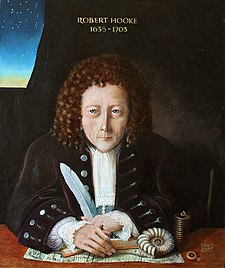
Robert Hooke is better than you

Today marks 308 years since the death of Robert Hooke, whom I know of because of having to learn Hooke's Law for AS Physics. (The extension of a spring is proportional to the force or load applied to it, or F = ke if you were wondering.) ((I know you weren't.)) Anyway, I thought he was just that bloke who did that thing with bits of wire or whatever it was that I knew at one point but now I just vaguely recall was important somehow. But he totally wasn't! Robert Hooke did lots of things; and here's a lovely list of his top ten achievements, chosen by me:

1) Being the last of four children living on the Isle of Wight, Hooke obviously wasn't in a position to go very far in life - or so it seemed. He took 20 lessons on the organ, however, and gained a chorister's place at Christ Church, Oxford, where he was introduced to many of the leading scientific thinkers of his day.

2) Hooke was one of the very first people to use a microscope to see cells (in cork, apparently), and so gave them the name 'cell', because he believed that they resembled the small quarters monks lived in.

3) He invented the balance spring in a watch independently and fifteen years before anyone else did (though others get the credit mainly because he was didn't patent his design).
4) He was an extremely talented artist - the picture on the right is a copy of his drawing of a louse - who drew pictures of anything he could find to stick under his microscope. 

5) He built a lot of specialized equipment for himself and other prominent scientists of the day to use when experimenting, one of the most famous examples being his invention of the vacuum pumps Robert Boyle used during his gas law experiments.

6) He was a well-known architect of his day, with building all over London being made to his specifications (though sadly few survive today).

7) He also built some of the first telescopes, and used them to study the planets, becoming an expert on the rotations of Mars and Jupiter.

8) After the Great Fire of London, in 1666, Hooke was asked to be one of the city's official Surveyors, tasked with assessing the damage caused by the fire, and the cost of repairs - an important job, given that 70,000 of the city's 80,000 inhabitants had their homes at least partially destroyed.

9) He was one of the first people to put forward an argument for biological evolution from looking at fossils - a very risky argument in the seventeenth century, given the status of the church.

10) Hooke argued with Isaac Newton about laws of gravity. And not many people can say that.  

Sunday, 9 January 2011

Unscrew the stars

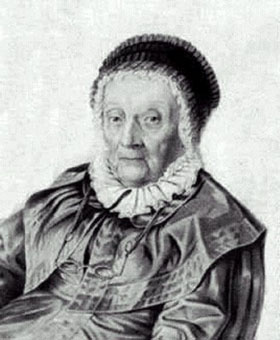
Today marks the 163rd deathday of Caroline Herschel, who was possibly one of the most extraordinary women I have ever come across. Deemed by her own parents 'too ugly to be married', the middle-class girl grew up in Hanover, Germany, ensured that she was well-educated and used her spinsterhood to her advantage - the time she would have spent caring for her husband and any children they may have had was spent studying space, and she eventually ended up being more famous than her brother William, also a keen astronomer. She produced two astronomical catalogs which are still in use today, and on top of all this, was a professionally-trained soprano, despite being a mere four foot three inches in height. Basically, she's another woman who makes me feel hopelessly inadequate, hoorah!

Caroline Herschel, 16/03/1750 - 09/01/1848

Herschel was one of six children born to Isaac and Anna Ilse Herschel, a middle-class couple from Hanover, Germany. Isaac was a keen musician, and took a job as a bandsman in the Prussian Army, encouraging his children - including Caroline - to become well-educated not just in the sciences and maths, but also in music. However, in 1760 when she was 10, she contracted typhus, a disease which left her growth stunted (she never grew taller than 4'3") and her body physically deformed. Her own father believed that she was too ugly to ever marry, and her mother discouraged her education after this point, believing that she would be more suited to becoming a house servant, which she did from the time of her father's death in 1767, until 1772, when she accepted an invitation from her brother to go and live with him in England.

Because the King of England (George II) was from Hanover, the two countries were united, and the citizens of Hanover were granted dual-citizenship, so William Herschel (Caroline's brother, who was 12 years older than her) had moved to England in 1766, he had found it easy to set up a house in Bath, from where he taught music and organised various concerts. When she arrived, William tutored her in singing, and she became such a good singer that she was the principle soprano of many of the concerts her brother organised, and was even offered a job as a singer in Birmingham, though she declined this.

Despite being talented musicians, both the Herschels' real passions lay in the field of astronomy. William not only enjoyed spending nights looking through telescopes at the stars, but also making his own telescopes. It was Caroline, however, who ultimately proved better than her brother at crafting the instruments - she possessed incredible dexterity and patience and was willing to spend many hours making the devices. As well as this, she taught herself how to properly record the observations her brother made in the style that the key astronomers of the day used. As this work was fairly mundane, her brother encouraged her to start using the telescopes herself, and during the 1780s and 1790s, she discovered many comets, becoming the first woman to do so. 

In 1781, William discovered the planet Uranus (though he initially believed it to be a comet) and was invited to name his discovery. His initial choice of 'George' in honour of the King was overruled in favour of 'Uranus' (after the Greek god of the sky, Ouranos - making it the only planet whose name comes from Greek mythology), but the King was clearly flattered enough to offer him the position of chief astronomer to the royal family. A few years later, in 1787, Caroline was awarded £50 per year by the King to work as William's assistant - an important milestone, as it marked the first time a woman was paid for scientific work.

When William married in 1788, the amount of work he did reduced, but Caroline's output increased, as her brother's wife was able to take over the general running of the household, freeing up more of her time to study space. As well as continuing to discover comets and nebulae, she produced the Catalogue of Stars - a rather dull, but incredibly useful piece of work. With stars being discovered left, right and centre, it was often impossible to tell if your 'new' star had already been spotted by someone a few years ago, especially as the previous catalogue that had been used to confirm new discoveries was many years old. In 1798, the Royal Society published her new catalogue, which contained all the stars from the previous list, with erroneous recordings removed, as well as 560 new stars. 

After William's death in 1822, Caroline returned to Hanover, though she continued to correspond with her brother's son, John, who was also a prominent scientist. In 1828, she was awarded the Gold Medal for Science by the Royal Society (the first of many awards); the next woman to be awarded the medal was Vera Rubin in 1996. She herself died in 1848, aged 97, and though it was true that she never married as her parents predicted, it was because of this that she was able to become one of the very first female scientists to gain international recognition for her work.    

Tuesday, 4 January 2011

War of Dried Fruit...oh wait

I am not the best person in the world at spelling, and rely heavily on computerized spellcheckers to ensure that my work is not riddled with errors. So when I read that on 4 January, 1903, Topsy the elephant was killed in the War of Currents, I immediately envisaged a couple of sultanas bravely facing an onslaught by a handful of raisins. In my defense, I should like to point out that the idea of AC and DC currents going to war with each other is just as nonsensical as dried fruit fighting (though in the interests of balance, fairness and embarrassing myself, I should point out that it was only after reading that Topsy was killed by Thomas Edison, via electrocution that it dawned on me that this particular war may have more to do with currents than currants...).

So let's dive right in to battle, shall we? The war of currents (sometimes known as the 'war of the currents', because Historians are crazy and wild like that), began in the late 1880s, when alternating current (AC) was invented and decided to go to war with direct current (DC).

When Thomas Edison invented the lightbulb, he used the electricity created by DC to make it work. DC works by having a constant current flowing through a wire in a similar manner to the way water flows through a pipe - how much water you have in your bucket (lightbulb) at the end depends on how fast the water flows through the pipe and how long it's been flowing for. In terms of electricity, this worked really well if you had a light switch on the wall and a lamp a few metres away that you wished to light. You could even share your electricity source with your neighbours, and they could have light too! It was all rather jolly.

There were, however, some significant problems with the system. If you wished to transfer power from its source at the power station to your home, you would need metallic cables which conducted electricity to do so. However, it took a lot of volts to light a bulb, and do the other things electricity was used for, and DC cannot be altered - if you need a high voltage at the end, you have to have a high voltage at the start, and keep that voltage high whilst the electricity travels to its end point. This proved slightly problematic, as if the current had to flow for distances greater than a mile, the wires would get so hot (due to the wasted heat energy being produced) that they would often melt and stop working. 

Edison's solution was to install lots of wires which ran over shorter distances (leading one observer to point out that this left the city of New York looking like a spider's web) but this proved dangerous, as during high winds or severe snowstorms, common in autumn and winter months, the wires would fall, electrocuting the people stood below them. In a particularly severe three day storm in March 1888, around four hundred people were killed this way. It was clear that the system couldn't continue for much longer.

Luckily, a very clever scientist named Nickola Tesla invented Alternating Current (by methods that, if I attempted to explain them, would result in my brain leaking out of my ears, so please just take my word on this one). AC, as the name suggests, alternates - sometimes it's positive, sometimes it's negative. For example, if an alternating current of 50 volts were to be measured using a oscilloscope (a fancy voltmeter), it would produce a sine wave that started at 0 volts, went up to 50, came back down to 0, went even further down to -50, came back up to 0, then further up to 50 again, and so on. 

Whilst this was very interesting to scientists, the main benefit that AC has to us all is that this enables it to be transformed - which basically means it starts off at a very high voltage at the power station, before immediately going through a transformer, which uses magic physics to lower the voltage significantly, but not the power produced from it, which means that the cables no longer heated up and melted, and power could be sent over huge distances. It was clear to everyone that this was a Jolly Good Thing Indeed, and preparations were made to switch over to AC, so that hundreds of lives could be saved, as well as many, many miles of copper cables.

Edison, however, had other ideas. He had patented the DC system, as was busy making huge amounts of money off it. He knew, though, that Tesla's invention was much better, and would soon make his old system obsolete, and therefore did everything in his power to discredit it. He claimed that it was a terribly dangerous thing - "a torrent rushing violently over a precipice" - and electrocuted animals with it to demonstrate its great danger, which is where the story of Topsy the elephant comes in.

(This is actually a really sorry tale - it made me weep, but then, anything to do with animals dying will do that... Topsy was an elephant who was kept in a zoo to perform for people, but by 1903 she had killed three men - one of whom had tried to force a lit cigarette down her throat. For this reason, she was deemed too dangerous to live, and was electrocuted using 6,600 volts of AC  by Edison, in an effort to demonstrate its dangers. He even filmed the event, and the footage is available on Wikipedia if you want to view it, but please don't - it's quite distressing...)

Tesla took the admirable stance of not saying anything derogatory about his rival and using just his own invention to prove how it was the best one to be used to provide electricity for the country. In 1897, the organizer of the Chicago World Fair asked Edison to supply the electrics for the event, and Edison agreed, requesting $1,000,000 to cover the costs of cables. Tesla approached the organizer, saying he could do it for half the price, and managed this feat. Edison was so annoyed that he banned Tesla and his sponsors from buying lightbulbs which he had patented. 

The damage to Edison's invention had been done, however. Once people saw that Tesla's alternating current was much cheaper and safer than using direct current, the switch was made, and within 10 years of the Chicago World Fair, 80% of American electricity was produced using AC. 

Which is all terribly interesting, but I'm a bit disappointed at the lack of dried fruit pummeling each other...