Showing posts with label royalty. Show all posts

Wednesday, 23 March 2011

Happy Families: the Tsars

Today, in 1801, Tsar Paul I of Russia died. Poor Paul did not have a very good life at all. I mean, don't get me wrong, he was the most powerful man in Russia for a time, so clearly he wasn't, you know, the most hard done by person on the planet. But he didn't have the easiest time of it, either.

He was the son of Catherine the Great and Grand Duke Peter. Except, he wasn't. Maybe In her memoirs, his mother strongly implied that he was the product of a relationship with one of her lovers. But his mother hated him, and wanted to cast doubt on his claim to the throne, so this, combined with his physical resemblance to his father, suggest that he actually was Peter's son. Regardless of which claim is true, the fact that this was discussed around him from an early age can't have done him much good really.

In 1764, when he was a mere 10 years old, Lord Buckingham, who was the British Ambassador at the Russian court, suggested that his mother would have had him killed if she wasn't afraid of the social consequences of being implicated in a murder. Again, the story has no clear basis in fact, but the rumors circulated wildly, and it is likely that Paul at least heard of them, even if he did not believe them.

Catherine's actions - whether true or not - do seem to have had some effect on him. When he was 16, he started suspecting that his mother was trying to kill him, and once openly accused her of filling his food with broken glass. Once he was old enough, Catherine ensured that he was married off and sent to live in various parts of the realm far away from her. She openly insulted him in front of her favourites when he was at court, and encouraged them to do the same, as well as lavishing luxurious gifts on them whilst ignoring her own son. 

Once his wife had given birth to a son - later to become Alexander I - Catherine was determined to exclude Paul from the line of succession. For this reason, when she eventually did die in 1796, Paul immediately seized control and demanded that any documents which stated that he was to be cut out of the line to the throne be destroyed.

Years of living in his mother's shadow had not prepared him well for rule, and he proved an inadequate monarch over his short five year reign. He was far too concerned with the possibility of his own assassination, and, whilst most people wrote off his crazy conspiracy theories as just that, he did at least have the satisfaction of eventually proving them wrong.

Or he would have, had he lived. Which, after being attacked with a sword, then strangled, then finally trampled to death in his bedroom, he did not. Poor Paul.   

Tuesday, 8 February 2011

Mary Queen of Scots[land]:

Today marks 424 years since the execution of Mary, Queen of Scots. You may be wondering why she was executed, and if you were, you'd be in luck, because I have read some books and I can now tell you why (I'm training to become a proper historian, and I believe that all I have to do is read enough books and stroke my beard thoughtfully enough and I'll be there). If you're not wondering why she was executed, you might want to stick around for the less gory bits, or perhaps go and eat a biscuit, or listen to a song that has my name in. Lovely.

Anyway, Mary, Queen of Scots. Born Mary Stuart, she was crowned Queen Mary I of Scotland at the ripe old age of six days (her father had died in battle), and in an episode which didn't really do much for stereotypes, the male courtiers in charge of the ceremony made a right mess of things, trying to get the baby to grasp a three foot sword and a scepter at the same time. Determined to ignore this rather poor start, they quickly arranged for her to become bethrothed to the French Dauphin (sadly, just a Prince and heir to the French throne, not the French Dolphin, as I initially misread, which would have been much more exciting) and packed her off to France.

There, Mary grew up, into an apparently tall and beautiful woman, who was capable of speaking French, English, Latin, Spanish, Greek and Italian. This proved a problem when the Dauphin snuffed it, and eighteen year old Mary headed back to her home country, where she couldn't understand a word her people were saying to her through their thick accents. However, this was soon to become the least of her troubles, as she was a strict Catholic, whereas most of the Scottish were ardent Presbyterians (like the Puritans, but with less general jolliness) which was to have dire consequences in years to come.

Anyway, Mary decided on returning to the country that she would like to get married again, which everyone thought was a splendid idea until they saw her choice of husband - the deeply unpopular sort-of contender for the throne Lord Darnley. Within two years, however, Darnley had managed to become equally unpopular with Mary herself, when he burst into her bedchamber with 20 men and murdered her private secretary in front of her, whilst she was heavily pregnant.

By this point, Mary decided that they were a bit beyond Couples Counseling, and arranged for her new lover to strangle then blow up her second husband, marrying him shortly after. This, ultimately, led to her undoing. There has never been any solid proof that Mary arranged or had any part in Darnley's murder, but there was enough implication there for her marriage to the supposed murderer to disgrace her enough that she had to abdicate and flee south into England and the arms of her cousin, Elizabeth I. 

Mary had thought that Elizabeth would support her in a sort of "we Queens had better stick together, eh?" way, but she was to be sorely disappointed. England and Scotland had been enemies for too long for the Queen of England to suddenly forget all their previous history together and help her cousin, and besides - she was a Catholic. This was quite a headache for Elizabeth. Keeping Mary in the country would make her a very visible rallying point for Catholic assassination plots - here was a ready made Queen just waiting to be stuck on the throne! - but deporting her meant that she would probably use the opportunity to muster an army and invade England. Executing her was not an option initially, as Elizabeth, whose own mother had been killed by her father, was very opposed to the ideas of both regicide and killing a cousin.

Therefore, she did what politicians have done for centuries since, and launched an inquiry. After much faffing and paper pushing, it was concluded that Mary should be kept captive in various different castles around the country. At first, probably at Elizabeth's assistance, her captivity was a fairly enjoyable experience - she was provided with plenty of clothes and comfortable furnishings, daily meals and was even allowed a few servants and ladies in waiting. The English queen's assistants, however, were not happy with this. Aware of the huge wars between Catholics and Protestants that were occurring on the continent, they believed that the only way to be rid of the 'threat' of the Scottish queen was to have her executed on some trumped up charges.

Elizabeth deliberated, for nineteen whole years. Eventually, "evidence" was found that strongly suggested Mary was plotting with other Catholics to have Elizabeth assassinated and replace her on the throne, and Elizabeth had no choice but to have her put to death. Many historians these days believe that much if not all of the evidence was fabricated, but at the time it was deemed substantial enough that Mary was put on trial, convicted of treason, and set to be executed. 

The execution did not go to plan. It took two or three blows for the axeman to completely sever her head; when he finally managed it and held it up by her hair, it dropped out of his grasp and rolled away, as what he was really gripping hold of was a wig, and after all that had taken place, the watching crowds were horrified, then presumably very relieved when her dress started whimpering and moving, and a small lapdog ran out of the clothing. Lovely.

It was not, it has been noted, a very dignified affair.    

Thursday, 20 January 2011

15 Reasons Why Wars Are Utterly Stupid & Daft:

15 Reasons Why Wars Are Utterly Stupid & Daft:

A list which came about because I am in the middle of revising for my final exam on the history of warfare, a topic I loathe, and the only interesting facts I manage to find about the battles are ones that are far to trivial to write about in an essay
and
because I like lists a lot. 
1) Shoes are important:
The Battle of Gettysburg, in 1863, remains the largest battle ever to have been fought on American soil. Ever. And do you know why it came about? Confederate General Robert E. Lee's army had no shoes, and when they found themselves outside the small Pennsylvanian town of Gettysburg, they thought to themselves, 'Oh hey guys, these Northerners have lots of shoes! Let's go raid the town for them!'. So they did. Where they happened to bump into the massive Union army, and realized that they'd better start fighting. The Confederates lost the battle, sadly, so I don't think they got any shoes at the end of it all. Sadface.

2) No really, they are: 
My friend Phil told me this story: during the Crimean War, the British were hopelessly disorganised, and decided to send all the left boots down to the Crimea on one ship, and all the right ones on another. And one of the ships sank. You couldn't make it up...

3) Actually, the whole of the Crimean War was a bit of a farce: 
I feel a bit bad making fun of the Charge of the Light Brigade, because so many people died, which is obviously a horrible thing, and would've been devastating for their families and everything, but the whole thing was completely preventable. British cavalry were given the order to charge up the 'Valley of Death', waving their swords about, whilst the Russians blasted them to pieces with cannons on all sides, thinking the British must be drunk.

4) To be honest, most nineteenth century wars were totally ridiculous:
Take the Franco-Austrian War of 1859, for example. It's a fairly insignificant one, in the grand scheme of things, but one thing it is famous for is the fact that the French had the bright idea to utilize the new railways to get their troops to the battlefield fresh and ready to fight, whereas the Austrians went on a two week march to get there. Anyway, the Austrians eventually cottoned on to this train business, and sent their reserve force to the next battle this way. Except they got off at the wrong station and completely missed the battle. Really.

5) And if they weren't missing battles, they were being inadequately prepared:
So a few years later, in 1870, the French were fighting the Prussians, and they had this amazing new weapon, called the matrielleuse. It was a forerunner to the machine gun, so if you were into slaughtering innocent soldiers, it should totally have been your weapon of choice. The Prussians should have been completely wiped out, but they weren't, because the French soldiers hadn't been trained in how to use their new gun, so it was effectively completely pointless.
 
6) Still, at least the French actually had an army:
After Charles II was restored to the throne, Parliament wanted to control his actions as they were afraid he'd do what his father had done, and plunge the country into Civil War again. Their solution, therefore, was to pay for and control the Navy, whilst allowing Charles an army only if he promised to pay for it himself. (Which, y'know, doesn't seem like the brightest move ever - 'Of course you can have an army! Just as long as you're in total control of it, not us! That'll ensure you won't try to attack us or anything...') In the end, Charles didn't attack the MPs (he was too busy partying and being a closet Catholic, two things which totally go together...) but for many years, the English army wasn't officially recognised as such, and the country at least technically had no army. 

7) However rubbish and unofficial the English army was, at least it wasn't full of sheep:
So the Civil Wars themselves were very complex, and their origins even more so, but one of the reasons they occurred was because Charles I needed money from Parliament for a war he was fighting in Scotland - the Bishops' War. In this war, England and Scotland were fighting over Bibles (as you do...), but the English army was much larger than the Scottish one, so the Scottish generals found themselves in a bit of a quandary. They decided that if they could trick the English into thinking their army was much larger than it was, they might be unwilling to fight them - and this plan turned out to be a good one. They did indeed manage to trick the English, by padding out their ranks with sheep, whom the English thought were...particularly woolly soldiers? God knows how this one worked...

8) Mind you, at least they weren't being paid in wool:
During the 100 Years' War, coinage was in short supply, so the English soldiers were paid in sacks of wool. Because all a fighting bloke really wants to do is learn to knit...

9) And about that '100' Years' War business:
Yeah, it actually lasted 116 years. But looking on the bright side, standards in numeracy had improved immeasurably by the time the Seven Years' War rolled round, and that ended bang on time, in 1763.

10) Also, at least numeric names make sense:
100 Years' War, 30 Years' War, Seven Years' War - they're all fairly logical, no? War of 1812 - that's another fairly self-explanatory one. The War of Jenkins' Ear...yeah, perhaps not. Though thinking about it, it started because Captain Jenkins had his Ear cut off by Spanish coast guards, so the name isn't that daft, even if the war itself was...

11) If you thought the names of wars were daft, wait until you hear what's going on on the battlefield:
So there's a very famous miscommunication about the First World War, where some field commander or another sent a message via telegram saying, "We're going to war, send reinforcements" but this got mistranslated and ended up as "We're going to a ball, send three and fourpence", and I can kind of see how this happened but honestly, didn't anyone think to check if this was the right message, coming from, y'know, a battlefield. War does this to people...  

12) Sometimes, people switch sides in the middle of conflicts:
Have you ever watched a children's cartoon and seen one of those montages where the good guys chase the monster through a door, then you see them turning around with the monster chasing them, then next thing you know, they're chasing the monster again, and no one knows what's going on? You have? Good. Visualize that happening in real life, 'cause it did: in 1460, the Earl of Warwick invaded (I'm assuming from some far distant land, and not, y'know, the well known island of Warwickshire...) captured Henry VI and installed Edward IV on the throne. Ten years later, in 1470, Warwick invaded again (oh who knows, maybe the Midlands were suffering from a lot of flooding around that time...), this time reinstalling Henry VI. You couldn't make it up...


13) We didn't get much better in World War Two either:
So Dunkirk was this terribly disorganised thing, where a load of British soldiers were trapped on a beach in Normandy with German soldiers advancing towards them and readying their planes to fly over and drop bombs on them, so the government requisitioned every ship on the south coast, even little two or three man fisher-boats to go out and rescue them, and they managed it, securing the rescue of the soldiers trapped on the beaches. In fact, everyone was so elated by the events that Winston Churchill had to make a special radio broadcast reminding the country that this wasn't actually a victory - in fact, it was a pretty awful defeat.


14)Anyway, sometimes you don't even need to fight, you can just employ a terrible euphemism plonk your warship in someone else's harbour:
As the British did when the Portuguese threatened to renege on their promise to grant independence to Brazil. No shots were fired and no fighting happened, but a stern warning was issued, and the best ship in the Navy set sail for Lisbon just to reinforce the point.

15) And sometimes, you just need to sound convincing:
In 1823, President James Monroe issued the Monroe Doctrine to the rest of the world, which basically said "Hey you guys? Yeah, don't attack us, 'cause we'll so get you back worse". Well, I'm not sure he said it quite like that, but that was definitely the general gist of things. Anyway, Spain and Portugal, who had both been planning to continue or restart old wars, backed down completely upon hearing this. Even though, at the time, the US had no navy and a very poxy little army. So really, all you need to do is sound threatening enough!

Oh my God. Am I condoning bullying?! Oh dear...         

Monday, 29 November 2010

Mother Theresa (not that one)

Maria Theresa, Archduchess of Austria, Holy Roman Empress and Queen of Hungary and Bohemia died today in 1780. She was, to say the least, an interesting character. She ascended the throne in 1740, aged only 23, and ruled for another 40 years - the only female Empress in 650 years of the Hapsburg Dynasty. During her time on the throne, she brought about many reforms in the countries she ruled, from the structure of the army to providing adequate working conditions for the serfs. As well as this, she gave birth to no fewer than 16 children - her fifteenth child was Marie Antoinette. Some historians call her the savior of the Hapsburg Dynasty, and one of the earliest feminists. Others are more concerned with her religious intolerance and her absolute monarchy, claiming that this almost tyrannical regime means it is impossible to accept her as a true feminist, fighting for equality for all. A somewhat controversial figure, then.

The House of Hapsburg, of which Maria Theresa was a member, is almost impossible to sum up in one sentence. Very briefly speaking, they were the rulers of Austria (and the Austrian Empire, which covered much of the lands which today surround the country) from 1278-1780. After 1780, when Maria Theresa died, the dynasty became known as the House of Hapsburg-Lorraine, which ruled the country until it's dissolution in 1918. Between 1440 and 1806, they were also the rulers of the Holy Roman Empire, and in that time, Maria Theresa was the only female Empress - and indeed, queen (who ruled in her own right) of Hungary and Bohemia.

This came about because of a rule, known in Europe as the Salic Law, which prohibited a woman from inheriting her father's lands. When it became clear that Maria's father, Charles VI was not going to produce a son, leaving Maria as his sole heir, he had to pass a hurried law known as the Pragmatic Sanction which guaranteed her the right to the throne - but at a price, for both Maria and the Austrian Empire.

For Maria, the main problem was that, though he named her as his successor, Charles assumed that Maria's husband, Frances Stephen of Lorraine, would take control and therefore didn't bother to teach his daughter how government and state affairs worked. Maria was determined that this was not to be the case, and that she would rule her country herself. However, due to various ill-conceived wars, the Austrian army was weak, and very poor. When Fredrick II of Prussia invaded in 1740, just weeks after she had assumed the throne, he was very easily able to take Silesia (what was historically Poland) for Prussia, thus starting the (rather boringly named) War of Austrian Succession, which lasted until 1748.

Things were not looking good for Maria - she could not afford to take back the land she had lost, and to make matters worse, France and Bavaria had joined in with the conflict and invaded her country from the west. Determined not to lose any more land, she initiated various army reforms, such as doubling the number of troops and creating a centralized tax office which collected money to fund the army. Though she lost Silesia, when the war ended the rest of her empire was still in tact, and the leaders of the other European countries finally recognized her as queen in her own right.

There were a few years of peace, until Maria Theresa decided in 1756 that Austria was capable of taking Silesia back, if they formed an alliance with France and Russia. Fredrick however, decided that Prussia would not stand for this, formed an alliance with Great Britain and invaded Saxony, one of Austria's allies, starting the Seven Years' War, which ended bang on time in 1763. (So maybe I skipped over the events of this war, but again, it's something that's almost impossible to sum up in a few sentences. One of the first global wars, it involved the American colonies as well as most of Europe, and resulted in over 1 million deaths). The Austrian Empire survived the war mostly unscathed as a territory (though they lost many men in the bloodshed), although when she signed the treaty that ended that war, Maria signed away the rights to the area of Silesia, which now officially belonged to the Prussians (one wonders what the Silesians thought about all of this).

Two years after this, tragedy struck when Maria's husband, Frances, died unexpectedly. Unlike most diplomatic marriages of the eighteenth century and before, Maria and Frances had actually been very deeply in love (their sixteen children - a large number even by the standards of the day - could be seen as proof of this...) and therefore, from the day of his death until she herself died, on 29 November 1780, Maria Theresa chose to dress in the clothes of mourning, as well as becoming much more withdrawn.

She changed her foreign policy, so that it was much more focused on maintaining peace in her lands, rather than trying to win back Silesia and became very concerned with serf reform, passing rules which made working conditions easier and fairer for peasants throughout her lands. She passed also brought about several religious reforms, though these were mixed in terms of their liberalism. Although she granted equal status to Greek Catholics and Jesuits - an unusual practice for most Roman Catholic rulers - she was radical in her persecution and suppression of Jews and Protestants, believing them to be enemies of the state.

As well as this, she secured the marriage of her daughter Marie Antoinette to the heir to the throne of France, as well as several less high profile diplomatic marriages for her other children. The rest of her reign passed peaceably, though she did engage in frequent arguments with her son and heir Joseph, as his plans for the empire were radically different from hers. For that reason, she decided not to abdicate, as many of the government officials thought she should, and Joseph had to wait until her death before assuming the throne. 

Though Maria Theresa was not a feminist in the true sense of the word (passing a rule which prevented courtiers from coming to watch her give birth, which they had commonly been able to do - almost like a spectator sport - was more for her own benefit to save herself embarrassment and indignity, rather than it being part of her great feminist principles), she was interested in reform for her country and actively pursued reforms for the poorest people in the empire, which was very unusual for the time. Her religious persecution, though harsh and unfair, was extremely typical of other rulers at the time, and was mostly a result of her very Catholic upbringing. Though she was not perfect, it would be fair to say that, in general, her support for the poorest in the country was radical, and her economic and military reforms helped to save the empire which, when she ascended the throne, had been on the brink of disaster. 

She also did all of this without any formal education in state affairs or how to most effectively rule an extremely large empire, which either goes to show that she was a very intelligent and shrewd woman, or that being Emperor (or Empress) was not nearly as hard as some historians would have you believe...    

Wednesday, 24 November 2010

Queen Mags

On 18 November, 1541, Margaret Tudor died. Um, possibly. Some of the sources I've read suggest she died on 18 November and some suggest 18 October, but as I'd like to write about her today and not a battle or the second congress of the Senegalese Socialist Party, we'll say that she died on 18 November. 

Maybe we can ignore the specifics and just congratulate her on living to the ripe old age of 51 which is pretty impressive in a time when the average life expectancy was only 35. (This would mean that I, at 18, would have passed the halfway mark in my life, which is a terrifying thing, as so far I have only achieved a bunch of GCSEs and the ability to do circular breathing for 10 seconds at a time. I should have children by now, if I was a sixteenth century girl. What a horrible thought.) 
 
Anyway, I don't want to end her life before I begin it, so to speak, because Margaret actually had quite an interesting one. She was born on 29 November, 1489 to Henry VII and his wife Elizabeth, their second child and first daughter, and grew up in the royal childrens' household (which also included Prince Arthur, who was supposed to take the throne until he died at the age of 18 and the future king Henry VIII) at Eltham. She and her siblings would have had their every whim catered to, though this did not prevent two of her younger siblings dying as infants, or her older brother dying of what some believe to be consumption, others diabetes. 

Despite this tragedy, Margaret's upbringing would have been mostly enjoyable. In order to make her a suitable royal consort, she was taught French, Latin, the clavichord, the lute and archery (so she could shoot prospective husbands who behaved inappropriately? I don't know...) Clearly, she was seen as a quick learner, though, as her husband had been picked out for her by the time she was six years old. She was to marry James VI of Scotland - 16 years her senior - in an attempt to end reunite the Scottish and English royal houses and end the 170 years of warfare between the two countries. In order for the two to marry however, a papal dispensation was required as Margaret and James were fourth cousins, and therefore too closely related to be marrying each other without special permission. However, after several years of negotiations, treaties and proxy weddings, the couple were married in Edinburgh on 8 August 1503, when Margaret was 13 and James 30. Though it was hardly the most romantic of matches, by all accounts the two came to, if not love each other, at least hold each other in great affection.

The first years of her marriage were not happy ones for Margaret. The year before she traveled to Scotland, both her mother and oldest brother died. Between 1506 and 1509, she fell pregnant 3 times, but all of the babies died in infancy. A letter to her father survives: 


The different writing at the bottom is Margaret's own - she wrote of her homesickness and unhappiness in Scotland, and her feelings can only have be exacerbated in 1509 when she learned of her father's death. A few years later, however, in 1512, things took a turn for the better when she gave birth to a healthy baby, whom she christened James, after his father. (James was the father of Mary, Queen of Scots and grandfather of another James, who became James I of England in 1603.) 

Things weren't so good for long. Tensions had been mounting between James and Henry, newly crowned King of England and they reached a peak in 1513, when the English Army marched northwards to meet the Scottish. The met at Flodden Field on 9th September and fought, with heavy losses - including Margaret's husband, leaving her pregnant and regent until their baby son was old enough to rule by himself.

This marked the start of an even more troubled period of Margaret's life. Though James IV's will stated that she may only remain regent as long as she also remained unmarried, she ignored this and remarried the powerful and fabulously named Archibald Douglass, Earl of Angus. He had many equally powerful enemies amongst the Scottish lords, however, and they decided to remove Margaret from the regency, deny her access to her children (the baby she was carrying at the time of the King's death survived, and was christened Alexander) and not pay her the income she was entitled to. 

She and her husband fled to England in September 1515, where they remained in her brother James' (yeah yeah, I know, they just weren't very imaginative back then, okay?) castle over the winter as Margaret fell very ill. Come the summer, she traveled further down south to London to see her brother Henry, the King, whilst Angus went back to Scotland.

There, he took a mistress, leaving Margaret with no money, no power, almost no contact with her son, and a terrible marriage. In March 1527, after nearly 10 years, the Pope granted her an annulment and her son James, aged 16, sent his regents away and began ruling the country in his own right. The last few years of Margaret's life were relatively peaceful and happy, though they did have their ups and downs. Despite having a fairly good relationship with her son, they disagreed on who he should marry, with James ignoring his mother's pleas for an English match, preferring to marry a French Princess, who bore him a daughter and heir, Mary, Queen of Scots. James could be forgiven, however, for taking his mother's romantic advice with a pinch of salt - she married a third time to one Henry Stewart, who took a mistress and her money, exactly like her second husband had done.

Eventually, she died (probably of a stroke) at a castle in Edinburgh, on 18 November 1541. Or maybe 18 October... But she was definitely buried in St John's Abbey in Perth, so if you're ever there and want to rant about your ex-husband, I'm sure her ghost would be very sympathetic. 

Saturday, 13 November 2010

Somewhat Unexpected

So, on 13 November 1002, Ethelred the Unready (King of England) ordered the killing of all the Danes in the land. This has become known as the St. Brice's Day Massacre, and really isn't a very cheerful thing at all, therefore makes an excellent topic for a gloomy Saturday night, no?

One of the main problems with History is that people don't really remember the good times (unless something really, really good happened). For example, the reign of Henry VII was a fairly happy and prosperous one - the nation had plenty of money, there was not a lot of disease or famine (well, no more than people at the time were used to) and he didn't partake in any major battles or wars (not including the Battle of Bosworth Field, where he stole the crown from Richard III...). Anyway, things were all really rather cheerful, if not ecstatically wonderful, until Henry VIII took the throne. 

Initially, he was well loved - he was reportedly very tall and handsome, and inherited a peaceable country in very good economic shape, so people had no cause to complain, really - and then things went downhill a bit. The Reformation caused massive disturbances throughout the land (though admittedly, not as much as they would later cause in the reigns of his three children) and throughout the Court - especially concerning his many marriages. He was not a spendthrift, like his father had been and threw money away on lavish feats, Court entertainments and castles, and the country soon became very poor - something even the sacking of the monasteries (a move which proved very unpopular in some circles) couldn't reverse. There were a few wars and rebellions, and by the time he died, in 1547, the country was in a much worse shape than when he had ascended the throne, in 1509.

And it is his reign, rather than his father's, that we remember the most about.

Now, you could argue that that is because his reign was longer (38 years, in comparison to his father's 12) so there was simply more time for more events to happen in - or that he simply did more things - marrying six times instead of once and breaking from the Roman Church, for example, and you would have a point. But ultimately, very little "of interest" happened in Henry VII's reign because it was all so...normal. There were no cataclysmic, drastic events, just boringly everyday ones - and they don't make History.

This is a very long-winded way of saying "No one would really remember Ethelred the Unready if it wasn't for the St. Brice's Day Massacre because most other events in his reign were a bit normal and boring and fairly average for the time, but then this happened and it was kind of a big deal so people like to write about it and it's become important". (Which in itself is rather long-winded...)

Anyway, Ethelred the Unready (who's name, surprisingly, is accepted by the American English spell checker I can't work out how to change to English) was born in 968 and ascended the throne at the age of 10. Clearly, because of his age, he had members of the Witan (I suppose you could call this a forerunner to Parliament, but it wasn't really - it was more a bunch of super rich nobels, all male of course, vying to see who could have the most influence over the King) to advise him...only they weren't very good at doing that. 

The Vikings (aka the Danes) had been conducting a campaign of destruction for many many years, and each King had to come up with a way of dealing with them. One of Ethelred's grandfathers, Alfred the Great (yes, the one who becomes King Arthur in the legends) managed to unite the English kingdoms and expel them by fighting with them until they surrendered, but for young Ethelred, this wasn't really an option. Instead, he was advised to pay off the Vikings.

For a few years this worked - though the taxes on his subjects were crippling, they managed to raise enough to pay the Danegeld ('Dane Gold...which was actually paid in silver)...until the Vikings demanded even greater payments, and invaded the country when they were not supplied with them. Obviously, this didn't go down to well with the English, which sent Ethelred (and his advisers) into a panic, so he did the only thing he could think of. On 13 November, 1002, he ordered the massacre of all Danes living in England.

The commands weren't exactly widely obeyed, and whilst it would have obviously been horrible for those Danes who had been living in the country for decades and become, in their minds, English to watch their family members be murdered, or be killed themselves, the event wasn't quite the massacre it is often made out to be. There are no figures available for the numbers killed, though we can see evidence of pockets of destruction still - earlier this year, in fact, the remains of between 34 and 38 men were found at St. John's College in Oxford, who are believed to have been killed in the massacre. However, the killings were mostly concentrated around the Southern parts of the country, particularly main towns Oxford and London, but fewer people were killed in the North, which is interesting because that is where most of the Vikings' attacks were centered.

Going back to my original point, this is clearly a Big Bad Event, and it is still well remembered today - in fact, it's the thing that Ethelred is most famous for. Not even his losing the crown to Swein Forkbeard (no, really...) and having to escape to France for a few years in exile come as high up on his list of 'achievements'.

And that is a shame, because Ethelred, for all his poor decisions (which may not have been his own fault - the meaning of 'unready' has changed since it was first bestowed upon him, and, back in his day, meant 'ill advised' rather than 'unprepared'. It was meant to be a pun, as Ethelred translates to 'good advise'...but I'm not sure I get Anglo-Saxon humour...) did actually do some pretty good things. Even with the large amounts of tax which were imposed on the country as a result of the Danegeld, his reign brought with it relatively good economic prosperity, and his judicial reforms, brought about by Archbishop Wulfstan, were the origin of the American grand jury, some say.

But "there was quite a bit of money floating about and we were starting to have a bit of a court system" doesn't sell books or films as well as "murder! Fighting! Great doom and gloom!" does. Which is probably why Eastenders is so popular...

Saturday, 16 October 2010

The She-King

So today I was going to write about this being the day that Marie Antoinette was guillotined on, in 1793 as part of the French Revolution. But then something else caught my eye and I decided to write about that, instead. I should like to pretend that this is due to my inner republican not wanting to give the royals anymore time that I absolutely have to (even when they're being beheaded...) or maybe wanting to throw some light on a 'lesser' historical event which has become overshadowed by the French Queen's beheading. That would be a very intellectual stance. I wouldn't want you to think that I was picking what I was going to write about today because I spotted the word 'Hedwig' in it, and it excited my inner Harry Potter nerd. Because that, of course, would be totally false...

On 16 October, 1384, Jadwiga of Poland was crowned King of...er...Poland, which is more intriguing than it first seems because Jadwiga was actually a she and it wasn't like they had the skills for sex-change operations in the fourteenth century (the castrate don't count, as they still had their original sex-organs, just not fully functioning ones...). So Jadwiga managed to retain her femaleness, we can assume, whilst still being a King. Why, you may ask? Because of our shitty patriarchal society. Because, until this point, as in most of Europe, a Queen had not yet ruled the country on her own - preceding Queens had been Queen regnants, meaning they only held that position because they married the King at the time. Jadwiga was crowned King to show that she was a sovereign in her own right, which I guess is early feminism, maybe.

(The first English Queen, for comparison, was "Bloody" Mary I, who ruled from 1553-1558. Some people believe that Matilda [also sometimes called Maud] was the first Queen of England, but this is technically incorrect - though she was the previous King's daughter and her son was crowned King, she herself never had a coronation; was only 'on the throne' for a few months in 1141; didn't have the support of at least half of the country's nobles [due to the Civil War over whether she or her cousin Stephen should be ruling] and wasn't exactly in it to further the feminist cause, more to further the amount of land and money she owned.)  

But back to Jadwiga the sort-of feminist. She was born sometime between 3 October 1374 and 18 February 1374. I have been unable to establish the exact reason for the discrepancy in recording her birth date, but I think we can safely say it has more to do with poor clerical administration than her mother going through the longest labour ever. She spent some time growing up in the Viennese Court and became betrothed, at the age of four to William of Hapsburg, though this was later called off at the behest of Polish nobles, and she instead became engaged and then married to Jagiello, Grand Duke of Lithuania when she was the ripe old age of 12 and he 26. When they married, in 1386, Jagiello changed his name to Ladislaus and was also crowned King of Poland, which must have been quite confusing to explain to the neighbours.


Jadwiga, King of Poland - 1373/4-1399

By all accounts, Jadwiga was a great beauty with long blonde hair and blue eyes (though I'm not sure how popular you would have been in the court if you had written that she was as ugly as sin), and surprisingly tall for a medieval lady - an excavation of her remains in the 1970s put her at an impressive 1.8m. She was also very clever, speaking Polish, Bosnian, German, Hungarian, Serbian and Latin as well as having an interest in the arts, music and science. She was incredibly pious and devout, and apparently had enough miracles attached to her for Pope John Paul II to canonize her in 1997. These days, you can refer to her as Saint Jadwiga, or, in English, Saint Hedwig, which pleases my inner nerd probably more than it should.

Sadly, Jadwiga died one month after giving birth, along with her baby daughter at the age of only 26, though her husband continued to rule Poland for another 35 years. She had left her jewels to Krakow Academy to finance its renovation. Krakow Academy is today known as Jagiellonian University and is still going to this day.    

Thursday, 14 October 2010

1066 And All That

Everyone knows that on 14th October, 1066 William the Conqueror won the Battle of Hastings by slaying Harold Godwinson whilst he rode his horse shooting an arrow in Harold's eye defeating the English troops, and most people know how it happened (if in doubt, just witter on about hills and 'the advantage' and superiority . . . actually, this will make you seem knowledgeable about almost all battles that have ever occurred). But fewer people know the ins and outs of why it actually happened, preferring to see William as the evil Frenchman who came in and stole the crown from the rightful heir. As usual, if only it were that simple . . .

There is an old English king who's name you have to be very careful how you spell - Cnut (no, really). You might have heard of him as the King who tried to stop the tides and he's generally portrayed as a bit of a div, but this couldn't be further from the truth. Cnut was Danish, a Viking who took control of England as well as the Scandinavian countries and he was very clever. The tide story has been manipulated over the years - he was actually trying to prove that no one, not even the King, could control the weather - and he pretty much let the British get on with ruling the country themselves, accepting that the laws already in place were good ones, and he wasn't going to be the one to rock the boat. "Letting Britain get on with ruling itself" meant that the top lords were in charge, controlling everything, sometimes acting fairly, sometimes not but deferring to Cnut where he required it. One of these Lords was Earl Godwine, who was a bit of a suck-up - he married a Danish aristocrat and gave his children Viking names - Harold and Tostig.

Anyway, Cnut snuffed it in 1035 and his two sons Harold and Harthacnut had to battle it out as to who became King. But Harthacnut (I love writing that . . .) wasn't really that interested in England, preferring to rule Scandinavia so Harold got the throne - only not for long. He died a very gorey death, almost certainly on Earl Godwine's orders. You see, Mr. Godwine senior had a plan - a descendant of the House of Wessex (the line of English kings who had been in charge before the Vikings came over), called Edward, had been sent over to Normandy to be raised in safety over there. Edward was now an adult - and in full position to be crowned King of England. Godwine reckoned that he could sponsor Edward, help him to regain the throne and support him, and in return Edward could marry his daughter, Edith and the Godwines would therefore have a direct line to the throne when Edward died (which, knowing the Earl's ways, might have happened sooner than expected).

So, Edward was crowned King in 1041 with help from Godwine, and married Edith. But he wasn't actually that keen on the Earl and didn't trust him, so instead spent his time trying to build up and utilise his cross-channel connections with his friends back in Normandy. Through this, he must have started to hear of "William the Bastard" - the Duke of Normandy's illegitimate son by one of the palace maids - who was starting to build up a brutal reputation (the Normans' decendancy from a Viking tribe may have had something to do with this).

The final straw for Edward regarding the Godwines, though, came when the Earl attacked some Norman knights whom Edward had invited over, upon their arrival. Edward removed them of their property and sent the Earl and his sons packing. He and two of his sons went to join a third son, Tostig, in Flanders, and his fourth son, Harold escaped to Ireland. Edith was shut up in a convent. Now, Edward chose not to remarry and it was becoming increasingly clear that he was to produce no heirs. Some people believe that this is because he was gay but I personally don't believe that to be true. There have definitely been gay monarchs in the past - Edward II is the classic example - and there is much evidence to show who their lovers were. But with Edward (who was later to become known as 'the Confessor'), there's no evidence to suggest he had any lovers - male or female - so I think that he was possibly just asexual.

Anyway, there were no kids, so he had to look elsewhere for a heir - and here comes the bit that all the Norman accounts swear are definitive proof that William was the chosen one. In 1051, Edward chose a new Archbishop of Canterbury, and sent him to Rome to have the appointment approved by the Pope. But before he got there, the Archbishop was instructed to stop off in Normandy and inform William that Edward had chosen him as his successor. William's claim to the throne was tenuous at best - they were barely related, mere second cousins once removed - but Edward did not want to see the crown fall back into the hands of the Vikings, or worse, the Godwines. 

However, Edward had underestimated both the Godwines' popularity and the Normans' unpopularity. On hearing of his plans to make William his successor, Edward came under a lot of pressure from the other chief lords and earls who were friends of the Godwines and in 1052 had to perform an embarrassing climbdown, reinstating the Earl and apologising to him. This would have been mortifying for Edward - Earl Godwine was now in charge in all but name - Edward had authority but very little power. 

Then, in 1053, the Earl died. His son Harold rose up to fill his shoes - and then some. Everyone loved him - he was tall, handsome, and, when he defeated a Welsh army and took control of a large part of the country, nobles and commoners across the land (though presumably not in Wales) believed he could do no wrong. He was indispensable, keeping the ruffians off the borders of England, the King's right hand man. It seemed inevitable that he would have dreams of becoming king. Then, for some reason no one's quite sure about, Harold ended up in William's court in 1064. This is where the Bayeux Tapestry begins. At first, the two acted like comrades - William looking after Harold; the two of them offering up sisters for marriage here there and everywhere - but it soon became clear that they were not equal comrades. William made Harold one of his knights, and Harold swore an Oath.

In medieval Europe, Oaths were taken incredibly seriously. Unless you wanted the wrath of all that was holy coming down upon your head, you did not take one in vain. Anyway, as usual, there is contention as to exactly what the Oath said - Harold's supporters say he just promised to be William's man in England, but not to help defend his right to the throne; William's that he promised to help him become crowned king. He returned to England, to await Edward's death. The King obliged in 1066 - without having officially named a successor.

This didn't actually matter too much - the witan (council of lords who were in charge, a very non-democratic forerunner to Parliament) had to approve the previous King's choice before he could be crowned, or name a successor if the previous King hadn't. To nobody's surprise, Harold Godwineson was chosen and he quickly became King Harold.

Of course, this quickly led to other troubles - a Viking claim to the throne led by Harald Hardrada with aid from t'other Harold's estranged brother Tostig and of course William himself invading and conquering, but I'll stop here. I hope you enjoyed this monster of a post :) 

Friday, 8 October 2010

If I could explain it any better I'm sure I would

I'm a bit sad today. Not seriously so, you understand; it's mostly loneliness. I've taken a gap year, and all my friends have now jetted off to exotic locals Coventry, Wales, Manchester and the like to study new and exciting subjects Chaucer and Mathematics. Still, whatever floats their boats, eh? I, of course, don't begrudge them their time or happiness at their various universities - indeed, I am glad they all seem to be enjoying it so much. But sometimes, when I'm stuck in a tiny village with nothing going on in the arse end of nowhere, things do get a bit lonely.

And yet! It does not necessarily have to be so. I haven't really felt lonely all day - it's only now, when they're all out at the pub or various clubs, having lots of fun that I really miss them, because they're not here to talk to me. Over the course of today, I have spoken to my friends in Wales, Manchester, Shropshire, Coventry and Birmingham via a combination of email, instant message, text message, Skype, Facebook and Twitter (because I am cutting edge a poncy middle class child). If I wasn't so socially retarded, I could even phone them and see how their days had been. In a few weeks, I shall hop on a train and even visit a few of them.

So actually, I'm very lucky. A lot of people, even in this day and age, do not have the option to do any of this. Further back in time, very few people did. Carrier pigeons, whilst generally reliable, aren't always the speediest forms of communication, though they did have the advantage of being less likely to betray you or be intercepted than a rider on horseback was. If you wanted to stay in touch with someone in the thirteenth century, your options were pretty limited.

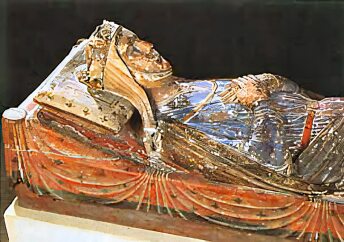
This brings me to Isabella of Angoulême. Clearly... On this day, in 1200, she was crowned Queen Consort of England, a few months after her marriage to King John I. This is Isabella (obviously quite a few years after her marriage...):


I'm not sure if you can tell from her tomb, but when she married John, on August 24th of the same year, she was heralded as a great beauty - medieval Historians sometimes call her the Helen of the Middle Ages. This was a double edged sword for her - the British people were, apparently, pleased to have such a beautiful wife for their King (and there was me thinking the excessive photoshopping of women in magazines and the like to "bring them up" to the required "standard" was a modern thing...), but she turned said King into a lazy scoundrel. Kings were expected to get up at five o'clock in the morning (effing hell) whereas John used to like to stay in bed with her until nearly midday. This was terribly shocking to medieval sensibilities, and didn't exactly do much for John's reputation as a good-for-nothing waster. The common people of England deemed her a siren, and she was well known for being vain.

Isabella was also French, as you may have guessed. Again this was a double edged sword, as whilst the French had made up the ruling elite ever since the Norman Conquest of 1066, there were still some displaced English nobles who considered themselves - or, to be more precise, their daughters - more worthy of the throne. But she did manage to provide the country with five healthy children, including the future King Henry II, so she was forgiven most things.

Despite the fact that she was so vain, well known for having a terrible temper to match her husband's, a clear royalist and a snob, who detested her lower ranking once her husband had died, which left her merely Countess of Angoulême, I feel rather sorry for Isabella. She was born in 1188, and those who are good with numbers will have spotted that this made her a mere 12 years old when she married John (who was 32 at the time). She would have been relatively alone (I say relatively - clearly she had numerous servants with her, but none of the family and friends she had grown up with) in a foreign country, where most people treated her with suspicion, and, in the case of most men, gruesome lust. 

If I can be lonely, a mere two hour drive from most of my friends - nearer in some cases - with instant virtual access to them if I require - I cannot begin to imagine what life must have been like for Isabella, a little French girl, a pawn in some diplomatic marriage or another, traded off in exchange for money, or land, or both, suddenly thrust into the middle of English court life. I apologize if this has come across as very 'poor little rich girl'; that was not my intention. I merely wanted to raise the issue once again that things are never as straightforward as they first appear, particularly when it comes to History.

I really wish I didn't write so clinically, that my style was more prosaic. I'm not even sure I explained that clearly. If I could explain it any better, I'm sure I would...

Sunday, 3 October 2010

The True Prince of Wales

Having written such serious pieces the last couple of days, I think it's time we had something a little more lighthearted. It is also absolutely pouring with rain - horrible, slanted, icy rain, the kind that hits you from every angle and soaks through your waterproof - so I think it's also time we took a trip to Wales. On this day in 1283, the Prince of Gwynedd - Dafydd ap Gruffydd - became the first person to be executed by being hanged, drawn and quartered. A dubious honour indeed.

What exactly is hanging, drawing and quartering, I hear you ask? Let me explain. [Those of weak heart/mind/stomach should probably skip this paragraph.] First, you take your criminal and attach him to a horse - or maybe two horses, if he was a bit chubby - via a hurdle.You then draw him on the hurdle across town, to his place of execution. (So I guess it really should be called drawing, hanging and quartering...) Next, you string up your criminal (who is having this done to him because he's been convicted of High Treason by the way) and hang him until he's almost dead, before cutting him down. Then (and here comes the really gory bit), you cut off his 'privy members' and take out his bowels 'and burn them before him'. You would then have  him (and it was always him - women were merely burned at the stake, for the sake of 'decency') beheaded, and his body chopped into quarters and sent to various parts of the country, as a warning to anyone else who might have been considering committing a treasonous act. 

All this, of course, took place in a public arena - partially to maximize the indignity the criminal had to suffer, and partially because it was a great form of entertainment in Medieval Britain. (Anyone who is tutting about the uncivilized barbarians who make up medieval society should think carefully about the sorts of films people nowadays like to watch - the kind which have wimps like me hiding behind the sofa and sleeping with the light on for days, and imagine what they might think of us.)

And what had good old Dafydd done to deserve such a fate? He was sentenced "to be drawn to the gallows as a traitor to the King who made him a Knight, to be hanged as the murderer of the gentleman taken in the Castle of Hawarden, to have his limbs burnt because he had profaned by assassination the solemnity of Christ's passion and to have his quarters dispersed through the country because he had in different places compassed the death of his lord the king".

You see, after his brother died in 1282, Dafydd was proclaimed Prince of Wales and decided to attack Hawarden Castle in Shropshire as a display of power, which didn't exactly go down too well with Edward I, to whom Dafydd was supposed to be paying homage. Edward amassed an army, and by January 1283, had captured most of the heartland of Wales. Dafydd and his supporters held out for another six months or so, hiding in the valleys, but were eventually captured on 22 June. He was tried for high treason against the King (again, the first person to suffer this fate) in Chester, and naturally found guilty. His sons were imprisoned in Bristol Castle, for the rest of their lives, where they died in circumstances which can best be described as mysterious; his daughters sent to convents around the country. 

Because of this, Dafydd not only holds the title of a famous first, but also a famous last - he was the last Welsh Prince of Wales. Edward I made his eldest son (also called Edward) Prince of Wales on his birth, and the title has been held by the current monarch's eldest son ever since. 

One can understand why the Welsh may not be so happy about this arrangement... 

Saturday, 2 October 2010

A Tsar is Born

2nd October 1552 - conquest of Kazan by Ivan the Terrible


Ivan the Terrible, 25.08.1530 - 28.03.1584

So, Ivan the Terrible did some pretty terrible things, clearly. (It was after the victory in Kazan on this day in 1552 that he was given the name 'Grozny', or 'the Terrible'.) He was a Bad Person. The conquest of Kazan, which involved amongst other things, decimating the Muslim population and laying siege to the city for five months, took place in what is commonly known as his 'Good Reign'. At the age of 13, he had someone who had annoyed him thrown to a pit of ravenous hunting dogs. There wasn't much left of him, at the end of that debacle... As they say (probably. I've never actually heard anyone say this) "he's not the sort of man you'd want to meet down a dark alley in the dodgy part of town".

But that's not what I want to get into today. Today, I want to talk some more about this whole good versus evil thing that I touched on yesterday. Again, as with Hitler, I'm not going to try and excuse the bad things that Mr. Terrible (and I do hope someone called him that...) did. I would instead like to explore why he did those things, and show that things aren't always as straightforward as they first seem in History, as with everything else in life.

Ivan didn't exactly have what you'd call an easy childhood. By the age of seven, he and his deaf-mute brother were orphaned, and the nature of their parents' deaths had been suspicious to say the least. After their mother died, they were placed in the care of regents - the Russian Boyars, or rich, land-owning nobles. Though these men (of course, this was the sixteenth century. They were all men.) treated the princes with respect in public, in private they were treated horrifically, often roaming through the palace with no shoes or clothes, and had to beg for food. Frequent displays of power by the Boyars meant Ivan would have thought nothing of armed men bursting into his chambers in the night and removing whatever they could of value. Aged 13, one of his closest confidants was skinned alive and his remains left for public viewing in a Moscow square. 

Ivan wasn't perfect, by any means. This incident lead to the perpetrators being thrown to the dogs, as mentioned above, and Ivan had already started taking his frustrations out on animals. Still, he wasn't all bad. Aged 17, he was crowned Grand Prince of Russia, though he insisted upon taking the title of Tsar (Russian for Caesar) and thus became the first in a long line of rulers of the same name. The Russia he inherited was a messy, desolate place, with no roads, no banks and no infrastructure, and he set about introducing reforms where he could to try to make it a better place. 

He selected a bride from an untitled Boyar family - Anastasia Romanovna. By almost all accounts, theirs was a very happy, if somewhat short-lived marriage. It was Anastasia's death that brought upon the 'Bad Reign'. She had had a long, painful illness which lasted a good few years before she died, which according to most accounts, devastated Ivan. He believed that she, like his mother, had been poisoned by the noblemen at court. Interestingly, a twentieth century excavation by scientists showed that the bodies of both Ivan's wife and mother contained ten times the normal amount of mercury, even after allowing for the popular mercury based foundations worn by noblewomen (I'm not sure if you'd call the British Elizabethan's lead based products better or worse...).

Is it such a surprise that, with such a turbulent, dangerous and, to be frank, upsetting early life, Ivan did the terrible things that earned him his infamous nickname? Well, maybe, maybe not - these things are always subjective, after all. But it remains true that, early on in his reign, Ivan set in place a lot of reforms to make Russia a better place, even though many of his loved ones were killed by noblemen seeking to further their own ambitions. And okay, he did start sieges and wars which killed a lot of people. But this doesn't necessarily make him different from most sixteenth century rulers, most of whom don't have 'the Terrible' or a similar moniker attached to their name. Sometimes, History is unfair on you, and it's only those who look further who find out the whole story.

Oh, and here's something I came across which you might find useful in a pub quiz one day: Ivan's wife was called Anastasia Romanovna. Her family eventually became known as the Romanovs, and this dynasty ruled Russia in their own right as Tsars for many, many years - in fact, the last Tsar, Nicolas II, was a Romanov. So in that way, the first Tsar of Russia and the last Tsar of Russia were related to each other! Cool, no? No? Well, maybe it's just me then...