Thursday, 24 February 2011

A biography of Handel

Yesterday, it was the 326th anniversary of the birth of George Frideric Handel and today is the 300th anniversary of the first performance of Rinaldo, an opera he composed which also happened to be the first Italian opera written for the London stage. I think the universe is hinting to me that it is time I wrote about Handel (which, handily, is code for "I really like lists").
10 Facts About George Frederic Handel:

1) When he was born, Handel's father was already 63, and had high hopes for his son. He envisaged a career in law for the boy, but it soon became apparent that he had an enormous talent for music - and not only this, but he enjoyed spending hours playing instruments. Georg Handel Sr. was so alarmed by this development that he strictly forbade his son from going near any musical instrument, but Handel Jr. was having none of this. He somehow found a way to sneak a clavichord (a kind of early keyboard) into an attic room at the top of his house, and he would creep up there at night when everyone had gone to bed, to teach himself how to play.
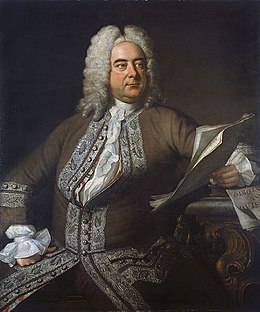
2) During Handel's early teens, he took a trip with his father to go and visit his half-brother Carl, who at the time was a valet to Duke Johann Adolf I. Legend has it that whilst he was there, the Duke overheard him playing on the church organ, and was delighted by what he heard. This helped Handel to convince his father that he should be allowed lessons in composition and keyboard technique, and so he studied under Friedrich Wilhelm Zachow. During this time, he played for Frederick I of Prussia, and met many contemporary composers, including Bononcini and Telemann.

3) In 1702, Handel went to the University of Halle to study Law as his father had wished, but did not enjoy it. After only a year, he dropped out and became instead a violinist at the Hamburg Opera House. Between 1705 and 1708, he wrote and possibly directed four operas which were performed there.

4) Handel met a member of the famous de' Medici family around 1706, and accepted their invitation to spend some time living in Rome with them. At the time, operatic music was banned by the Papal States, so instead he composed choral music for the church for performances in the city. He continued, however, to write operas which were performed elsewhere in Europe, including Agrippina, which had a then unprecedented run of 27 performances, and was the object of much critical acclaim. 
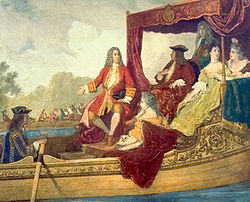
5) In 1710, Handel became Kapellmeister to the man who was soon to become King George I of England, and so moved to London when George did, in 1714. A Kapellmeister was a man who was in charge of music-making, and so Handel's role for the rest of his life was to compose as much music as possible, something he did to great aplomb.In July 1717, the Water Music was performed for the first time along the Thames, where it went down a storm. At around this point also, Handel decided that he was bored of composing operas, and ignored them entirely for about five years.

6) Fiscally, Handel was very lucky - he invested in the famous South Sea Company in 1716, but managed to sell his stocks in 1720, before the bubble burst, leaving him a very rich man. During his lifetime, he was heavily involved with charities, and gave much money to the Foundling Hospital in London, as well as to charities which helped impoverished musicians and their families.

7) His time in Britain can be split into three main periods. Between 1719 and 1734, he was employed by the Royal Academy of Music, during which time he continued to compose at an extremely fast rate. Some of his most famous works from this time include the operas Giulio Cesare and Rodelinda and Zadok the Priest, which he was commissioned to write for the coronation of George II, and has been been performed at every coronation ceremony since.

8) After his contract at the Royal Academy ended, it was expected by many people that Handel would retire; instead he chose to start a new company with his friend John Rich at Covent Garden Theatre. From 1734 until 1741, he composed whilst Rich directed, introducing many more theatrical elements to the performances for some of the first times. During this period, in the summer of 1737, Handel, aged 52, suffered a stroke. It was assumed he would never be able to perform, let alone compose, again, as the illness had seemed to affect his understanding, but he took himself off to a German spa town, where he would spend many hours a day in the hot baths. He was able to give impromptu piano recitals to the surprised costumers of the spa, and by the following year was well enough to return to composing in London.

9) His later life produced some of his most prolific works. On 13 April 1742, 26 men and five boys put on the first performance of the Messiah, a piece that remains as popular today as it was on first performance. A few years later, in 1749, he wrote the Music for the Royal Fireworks, and when it premiered, over 10,000 people attended. This was to be his last major composition - in August 1750 he suffered serious injury in a carriage accident and a couple of years later, he went blind. He survived until 1759, when he finally died on 14 April.

10) He was given a state funeral in Westminster Abbey, and over 3,000 mourners attended. His works had been incredibly popular, and though in the nineteenth century they were to fall out of favour, in more recent years he has regained his popularity. He never married, and in his will he left most of his possessions to his niece Johanna, though his art collection was auctioned posthumously. Often referred to as the "musician's musician", Handel was a favourite of Bach, who attempted to meet him on several occasions but was always unsuccessful, and later Mozart and Beethoven, who described him as, "he master of us all... the greatest composer that ever lived. I would uncover my head and kneel before his tomb".     

Tuesday, 22 February 2011

Sorceress on the Seine

So I'm never sure what I'm going to write about on any given day until I've gone on Wikipedia and read the brief description of what happened 'on this day' and seen who was born, and who died and so on. Anyway, on some days, nothing of real interest happens (or it was just wars and stuff and I am so sick of military history) and on other days, like today, loads has happened. 

For example, today marks the anniversary of George Washington's birth; the anniversary of the refounding of the Serbian Kingdom; the opening of the first Woolworth's; the day the Last Invasion of Britain began (which apparently has to be capitalized...); the first national conventions of both the Republican Party and the Prohibition Party (in separate years) and Dolly the sheep was cloned (yay, science!). So all of these things are clearly very Important and Significant and such and so I was wondering how I was going to get through the mountains of information out there about them and condense it down to a few paragraphs. Also, most of these are quite famous events, so a lot of people already know loads about them, which would probably make reading this quite boring.

But then, tucked away under the 'people who died on this day' section, I discovered Catherine Monvoisin, French sorceress. And I do love magic and fantasy, so I now present the life and times of a witch (who actually is pretty interesting!)

Catherine wasn't originally a witch. Born Catherine Deshayes, around 1640, she grew up around Paris and married a jeweller called Monvoisin. Unfortunately, Mr. Monvoisin wasn't a very good jeweller and they didn't have very much money at all, so Catherine started supplementing their income by practicing medicine - giving abortions or delivering babies as a midwife to women who needed them. This was not enough, however, so Catherine gave herself the name La Voisin and started practicing 'witchcraft'. At first, this was just face and palm reading, but soon she was providing love potions and poisons, and putting on shows, assisted by the magician Lesage (who was also her lover) and a renegade priest, who would perform a black mass - a parody of the Christian mass.

The ingredients lists for her love potions have been uncovered by historians, and well...I'm just glad I didn't have to try one of the poisons.  But anyway, if you maybe have a little crush on someone who's not reciprocating, why not slip a little something in a drink for them? The little somethings you could slip in could include: bones of toads, teeth of moles, Spanish flies, iron fillings (um...?), human blood or the dust of human remains. It'll totally work.

Anyway, these potions became very popular with the many mistresses of Louis XIV, four of whom at some point went to La Voisin and asked her to supply them with a poison to kill one of the other mistresses (and at one point, even the King himself). Maybe. Possibly. The 'evidence' for this is circumspect at best and even at the time, it could never be proven. 

However, sadly for La Voisin, the King's sister-in-law had died in 1676, and her death had been attributed to poison, supposedly given to her by the 'witch' Madeleine de Brinvilliers. Though it was later proven that her death was a result of a perforated peptic ulcer (do yourself a favour and don't Google image search that. Really.) the panic as a result of her 'poisoning' was still at its peak in Paris in 1679.

When La Voisin was accused of trying to kill one of the King's mistresses, she was swept up in a tide of fear and hysteria, and was naturally found guilty, even though no one could come up with any proper evidence. She was executed on 22 February 1680, burned at the stake for being a witch.     

Thursday, 17 February 2011

The Missouri Compromise and the dangers of history

On 17 February 1819, the United States Congress passed the Missouri Compromise, an event which led to Civil War and the death of thousands. 

The issue, you see, was the expansion of slavery - each state was allowed to rule whether slavery should be legal or illegal in their territory, and at that moment, the number of slave states and the number of free states was exactly equal. However, there was a lot of unpopulated territory in the country which was perfect for growing cotton, and the anti-slavery Northerners were very worried about Southern plantation owners upping sticks to one of these incredibly fertile areas, growing cotton, using slave power to harvest it and then deciding that they would like to make the area into a state of the United States, with senators and congressmen who voted in favour of slavery. This would obviously upset the balance of slave and free states, leaving the North at a disadvantage. 

They proposed that slavery be made illegal in all new states joining the Union, but this would clearly lead to a massive imbalance against the South, which they felt would be very unfair. So naturally a compromise had to be reached, and it was.

It was decided that Missouri would be brought into the Union as a slave state, but at the same time so would the state of Maine, as a free state, thus maintaining the balance. They then drew a big line across a map of the United States, and said that any state entering the Union below this line was permitted to allow slavery, and all those above, weren't. (They weren't just waving a marker pen about; the line in question was the 36°30' line of latitude so it did have some significance geographically.)

However, though the compromise worked in the early part of the nineteenth century, by the middle it was proving a great hindrance and eventually ended up causing Civil War.

Of course, it didn't. The problem with history is that it's impossible to exactly pin down one cause for a great event - some could feasibly argue that the Missouri Compromise caused Civil War, others might say that it was working just fine until it was scrapped in the 1850s by Senator Douglass, who believed that each state should have the right to vote on whether a state was 'free' or not, and introduced the Kansas-Nebraska Act to this effect (it was a nice idea, but led to all out war and violence in Kansas, with pro and anti slavery mobs rioting and sometimes killing each other).

Other causes of the Civil War might include, depending on your viewpoint: Abraham Lincoln's winning of the 1860 election on the Republican Party ticket; the huge chasm between Southern and Northern values; slavery itself; the fact that slavery was not outlawed in the whole country when the slave trade was; the Dred Scott court case and its ramifications or even, looking at the very short term, the fact that the Southern states seceded, formed the Confederate States of America and opened fire at Fort Sumter on Northern troops.

A good case could be made for all of those examples being the sole reason for war, but as usual in history, they acted together, and it was only a culmination of all the events which eventually caused war. It is possible, of course, to argue that a certain event was more significant that another event, but it is very, very rare that one person can categorically state that X and X alone was responsible for the American Civil War, or the Reformation, or the decision to give women the vote or whatever. 

This is why I love my subject. You can never be wrong (well, you could if you were to argue that Winston Churchill was the cause of the American Civil War, but very few people try to do this, oddly enough...), and you can argue (read: waffle) your way out of, or into any situation. But seriously, you do learn how to prioritize arguments; review the most important causes of any given event; and critically analyze primary and secondary sources as evidence for and against a particular line of thinking, all very important skills. Which is why the government's proposals for a shake up of the history curriculum are especially worrying; focusing as they do on just one form of history - the 'Britain and the Empire were excellent' one. Michael Gove should realize that just because he learnt it in should, doesn't make it true. If he was a proper student of history, he would know this already...      

Monday, 14 February 2011

A history of Valentine's Day

Even when single, I've never really minded Valentine's Day that much (I quite enjoy it in fact - you get all sorts of two-for-one deals on love hearts, and they are the best sweet ever) and that is mostly for one main reason: the original Valentine's Feast Day was to celebrate the Valentines (there were at least three) who were early Christians murdered for their beliefs by the Romans, which is possibly the least romantic thing I've ever heard. So anyone who tries to tell you some myth about how Valentine was a spurned lover who wrote a card to the daughter of the jailer who was imprisoning him for...something (I don't know, these myths aren't always very well written...) and this signifies the old adage that 'love conquers all, even death' and this signifies...er...something, is a liar.

Or, you know, something. One has to be a little bit bitter, after all. Keeping up appearances, and everything.

Anyway, despite these rather gruesome beginnings, St. Valentine's Day did eventually become associated with romantic love in the 14th century, when Geoffrey Chaucer wrote a poem commemorating the engagement of King Richard II and Anne of Bohemia (fun fact: they got married when they were both just 15 years old). A century later, in 1415, the first Valentine's card was sent, by Charles, duc d'Orleans, to his wife whilst he was imprisoned in the Tower of London. One hopes it was a good message, because he was to be kept captive for a further 24 years, and by the time he was released, his wife had died (so, naturally, he married again, as soon as he was set free). 

Cards became more and more popular in the following centuries - in the 16th, it was popular to send your lover a handmade card decorated with cupids, hearts and bows; in the 18th, one could begin to buy into the commercialized Valentine's Day, either by sending a lover one of the first printed cards or by transcribing a verse from Valentine Writers - a book of standard rhymes and greetings (how awkward would it be if you and your paramour sent each other the same poem, whilst hoping to convince each other that you were being original?); and by the 19th century, postmen were claiming a special allowance for their extra loads on the day. Also in the 19th century came the first mechanical Valentine's cards, my favourite of which had a figure that rolled it's eyes and stuck out its tongue when opened.

Today's traditional red rose first became part of the day's celebrations in 18th century France, with people imitating the love tokens given to Marie Antoinette by King Louis XVI. Coincidentally, red was also the colour their clothes became stained when their heads were chopped off by the French people in 1791.

Love hearts were invented in 1933, produced in a factory in Star Lane, in London, though they had to move out during the Blitz. They relocated to a disused mill in Darbyshire where they remain in production to this day.

Thank God. 

Thursday, 10 February 2011

Now you're just being daft

Here's another example of utter ridiculousness. I'm beginning to think that that's all this subject is. (Then I remember that my friends are doing things like Maths and Physics at university and I sort of feel a bit better. Ish).

But honestly, this is completely ridiculous. 

Today, according to wikipedia you might know, is St. Scholastica's Day (she's the patron saint of nuns, convulsive children and is invoked against storms and rain, apparently) and so, in 1335, when a riot occurred in Oxford on this day, they imaginatively called it the St. Scholastica's Day Riot. At least they thought to capitalize it...

The cause of the riot is depressingly mundane. Two young students of the university were drinking in the Swindlestock Tavern, when they decided that the ale they were drinking was not of the highest quality. Deciding, after several pints of said poor quality ale (I guess they had to check if it was all bad?), that this just would not do, they complained to the taverner. As so often happens, though, their complaints perhaps did not come across as they initially intended; words were had and things ended up with the taverner being beaten up by the two students.

Naturally, this was not an experience he enjoyed, and he decided that the only way to make up for it would be to organise a gang of locals to take on the students, which he swiftly did. He first approached the Mayor of Oxford for help, who asked the University's Chancellor to arrest the two students who had attacked the taverner. When it was made clear that this was not going to happen, a riot took place that lasted for two days and left around 30 locals and 63 students dead. This was probably going a bit far over a few drinks...

Eventually, the dispute was settled, after the King got wind of the Mayor of Oxford, John Barford riding into the countryside and calling for men to slay and smite the students, and ordered an investigation. A charter was drawn up, which stated that the Mayor and town councilors had to 'march bareheaded through the streets every year on St. Scholastica's Day and pay a penny for every scholar who was killed'. They were often pelted with makeshift weapons and jeered by the students whilst doing this, so naturally by 1825 the Mayor had gotten a bit of sick of the practice and refused to participate. After 470, no one from the university really bothered to complain, and the whole thing was dropped.

However, 600 years later, it was decided that the hatchet should finally be buried, and on 10 February 1955, the Mayor of Oxford was awarded an honorary degree by the University, and the University Chancellor was made an honorary freeman of the city.

This, naturally, made up for everything. Yes...     

Tuesday, 8 February 2011

Mary Queen of Scots[land]:

Today marks 424 years since the execution of Mary, Queen of Scots. You may be wondering why she was executed, and if you were, you'd be in luck, because I have read some books and I can now tell you why (I'm training to become a proper historian, and I believe that all I have to do is read enough books and stroke my beard thoughtfully enough and I'll be there). If you're not wondering why she was executed, you might want to stick around for the less gory bits, or perhaps go and eat a biscuit, or listen to a song that has my name in. Lovely.

Anyway, Mary, Queen of Scots. Born Mary Stuart, she was crowned Queen Mary I of Scotland at the ripe old age of six days (her father had died in battle), and in an episode which didn't really do much for stereotypes, the male courtiers in charge of the ceremony made a right mess of things, trying to get the baby to grasp a three foot sword and a scepter at the same time. Determined to ignore this rather poor start, they quickly arranged for her to become bethrothed to the French Dauphin (sadly, just a Prince and heir to the French throne, not the French Dolphin, as I initially misread, which would have been much more exciting) and packed her off to France.

There, Mary grew up, into an apparently tall and beautiful woman, who was capable of speaking French, English, Latin, Spanish, Greek and Italian. This proved a problem when the Dauphin snuffed it, and eighteen year old Mary headed back to her home country, where she couldn't understand a word her people were saying to her through their thick accents. However, this was soon to become the least of her troubles, as she was a strict Catholic, whereas most of the Scottish were ardent Presbyterians (like the Puritans, but with less general jolliness) which was to have dire consequences in years to come.

Anyway, Mary decided on returning to the country that she would like to get married again, which everyone thought was a splendid idea until they saw her choice of husband - the deeply unpopular sort-of contender for the throne Lord Darnley. Within two years, however, Darnley had managed to become equally unpopular with Mary herself, when he burst into her bedchamber with 20 men and murdered her private secretary in front of her, whilst she was heavily pregnant.

By this point, Mary decided that they were a bit beyond Couples Counseling, and arranged for her new lover to strangle then blow up her second husband, marrying him shortly after. This, ultimately, led to her undoing. There has never been any solid proof that Mary arranged or had any part in Darnley's murder, but there was enough implication there for her marriage to the supposed murderer to disgrace her enough that she had to abdicate and flee south into England and the arms of her cousin, Elizabeth I. 

Mary had thought that Elizabeth would support her in a sort of "we Queens had better stick together, eh?" way, but she was to be sorely disappointed. England and Scotland had been enemies for too long for the Queen of England to suddenly forget all their previous history together and help her cousin, and besides - she was a Catholic. This was quite a headache for Elizabeth. Keeping Mary in the country would make her a very visible rallying point for Catholic assassination plots - here was a ready made Queen just waiting to be stuck on the throne! - but deporting her meant that she would probably use the opportunity to muster an army and invade England. Executing her was not an option initially, as Elizabeth, whose own mother had been killed by her father, was very opposed to the ideas of both regicide and killing a cousin.

Therefore, she did what politicians have done for centuries since, and launched an inquiry. After much faffing and paper pushing, it was concluded that Mary should be kept captive in various different castles around the country. At first, probably at Elizabeth's assistance, her captivity was a fairly enjoyable experience - she was provided with plenty of clothes and comfortable furnishings, daily meals and was even allowed a few servants and ladies in waiting. The English queen's assistants, however, were not happy with this. Aware of the huge wars between Catholics and Protestants that were occurring on the continent, they believed that the only way to be rid of the 'threat' of the Scottish queen was to have her executed on some trumped up charges.

Elizabeth deliberated, for nineteen whole years. Eventually, "evidence" was found that strongly suggested Mary was plotting with other Catholics to have Elizabeth assassinated and replace her on the throne, and Elizabeth had no choice but to have her put to death. Many historians these days believe that much if not all of the evidence was fabricated, but at the time it was deemed substantial enough that Mary was put on trial, convicted of treason, and set to be executed. 

The execution did not go to plan. It took two or three blows for the axeman to completely sever her head; when he finally managed it and held it up by her hair, it dropped out of his grasp and rolled away, as what he was really gripping hold of was a wig, and after all that had taken place, the watching crowds were horrified, then presumably very relieved when her dress started whimpering and moving, and a small lapdog ran out of the clothing. Lovely.

It was not, it has been noted, a very dignified affair.    

Monday, 31 January 2011

Juxtaposition

I'd like to take a break from identifying cell organelles (yeah!...) to talk about the marvelously ironic country that is the United States of America. Flipping through the Wikipedia article on 31 January, you will discover that, on this day in 1865, the "United States Congress passes the Thirteenth Amendment to the Constitution of the United States, abolishing slavery", yet on this day in 1876, a mere eleven years later, the country "orders all Native Americans to move into reservations". Huh.

America is a very interesting country. It's only been officially independent since 1776, yet in that relatively short time, it has risen to become the world's greatest superpower. (You could argue for days, I am sure, as to whether this is a title it retains, but it is very true to say that it was the dominant world power for almost all of the twentieth century.) A melting pot of many, many different races and religions, and containing immigrants who often arrived incredibly poor, America in the eighteenth and nineteenth centuries had the potential to completely fail as a democracy, simply because of its diversity. From some countries, you had Catholics escaping persecution, other countries, Protestants and others still Jewish (and that's just counting the major European religions), yet these incredibly different groups of people managed to exist side by side once they were in America.

The sheer size of the country probably had something to do with this. There was enough room, if you so required, to pack up and move thousands of miles away from the people who were annoying you, and still be assured of land and space to call your own when you arrived there, unlike in the highly overcrowded European nations. Often, new states sprung up where people of the same religion congregated - Pennsylvania, for example, was founded (first as a colony, then later as a state) by William Penn, a very prominent Quaker leader, and the religion dominated the state's governance for decades; Utah was founded by Brigham Young, a leading Mormon and has retained that connection to the Mormon religion to this day.

Though there were instances of segregation such as these, there are other examples of many different nationalities and creeds living side by side. New York, for example, had a very diverse population simply because it was home to the largest immigration center in the country; California after 1848 had an equally diverse population because of the myriad prospectors arriving from all over the world hoping to try their luck in the gold rush.

This is not to say that the US was not without its problems. Slavery was not formally banned in the country until 1865, whereas most European countries had banned it much earlier in the century (Britain, for example had banned in 1833). Even after this point, treatment of black people, particularly in the Southern states, was often terrible - the so-called 'Jim Crow' laws continued right into the twentieth century, and the Civil Rights Movement was still (understandably) very active until over a century later, when ethnic minorities were finally granted equal rights.

Their treatment of the Native Americans was equally despicable - the forcible moving to reservations of the peoples was just the beginning of the end, with many "savages" having been treated as second class citizens since Europeans had first started coming over to the country. 

Women and other ethnic minorities were also often treated poorly, though in some cases, this was not much different to the rest of the world. Irish and Chinese immigrants were often little better than slaves, as they worked in highly dangerous occupations such as mining or building railways for an incredibly small wage, and no rights to protest, but, sadly, this was pretty much the same as the rest of the world. Though some states allowed women to vote in the late nineteenth century, the Nineteenth Amendment to the Constitution (which allowed universal women's suffrage) was passed in 1919, very comparable to most European countries. 

Obviously, the country was not perfect at all, particularly in their treatment of ethnic minorities, but it is truly remarkable that it was able to become such a dominant world power in so little time. They have often been held up as a bastion of democracy, and though clearly there are examples which can be found that illustrate that this was most definitely not true, there are plenty more examples to show that it is. Not for nothing do we still hold true the idea of the "American dream" - that a penniless man could come to the country, escape the rigid class systems of Europe, and make himself a millionaire. Naturally, these situations were very rare, but they did occasionally happen. Social class was much more fluid in eighteenth, nineteenth and early twentieth century  America than it was anywhere else.

It will be interesting to observe what direction the United States takes over the next few decades. Once a model of democracy, the right-wing Tea Partiers, such as Sarah Palin seem to be having more and more influence on life there - the recent shooting of Congresswoman Gabrielle Giffords and the other innocent victims is directly attributable to the violent rhetoric that is more and more forthcoming from certain political leaders; and the new Republican congress wants to restrict abortion still further, even going as far as redefining rape (you can be 'forcibly raped' or 'not really raped it was just a bit of harmless fun and who says a woman should be conscious during sex anyway') as if women who have been attacked haven't been through enough. Ironically, we may see, in a few decades time, the Middle Eastern countries that the US has been determined to invade in order to bring democracy to, actually being more democratic and allowing women more rights than America itself.

But who knows? I am a historian, not a fortune teller, after all.